How AlertD Works
AlertD is powered by a system of modular, purpose-built agents. Each one is designed to handle a specific job—whether that’s querying AWS APIs, interpreting CloudWatch metrics, or responding to natural language prompts.
When you ask a question, AlertD doesn’t just call a service or trigger a static response. Instead, it dynamically selects the right agent, which then writes, executes, and interprets a tailored execution plan.
The Agent Lifecycle
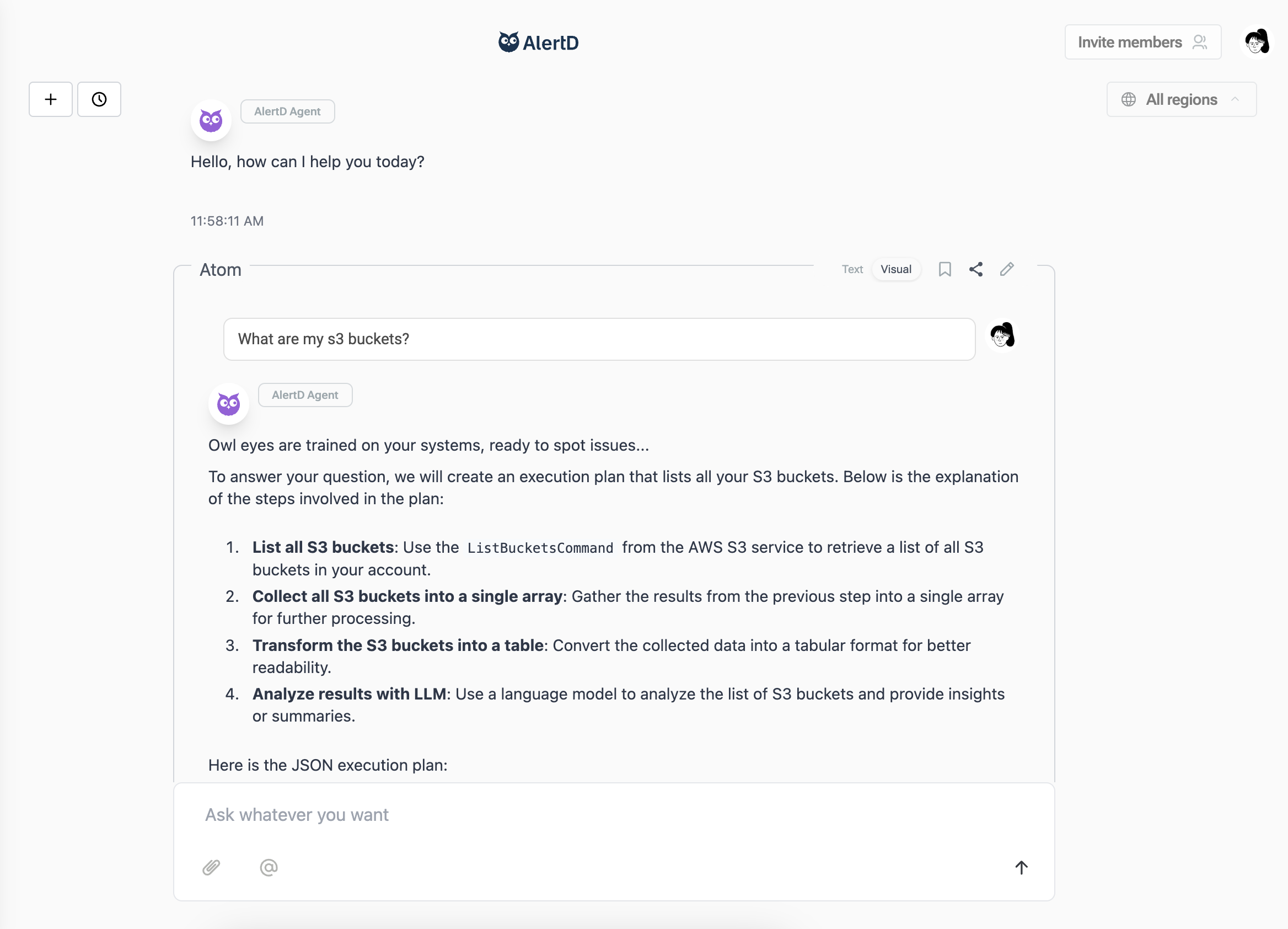
Every time you ask a question, AlertD creates a custom execution plan tailored to your prompt. Each agent follows a simple but powerful three-phase lifecycle:
Phase 1: Selection
When you ask a question, our main routing agent (we call it Flappy) figures out which specialized agent is best suited to help. This is called selection.
Example:
You ask: “What’s the replication lag on my RDS databases?”
Flappy chooses the RDS agent to take over.
The routing logic analyzes:
- Keywords in your question (RDS, replication, lag)
- AWS services mentioned
- Type of query (performance, configuration, cost)
- Contextual clues from previous questions
Phase 2: Plan Writing
Once selected, the agent builds a custom execution plan—a step-by-step blueprint that defines what data to fetch, how to process it, and how to present results.
Example plan steps:
- Call AWS RDS API to list all database instances
- Query CloudWatch metrics for replication lag
- Filter results to show only instances with lag > 0
- Transform data into a readable table
- Use LLM to analyze patterns and suggest fixes
You don’t need to build a plan manually—the agent handles that for you. But you can see and trace every step it took. See Execution Plans for more details on plan structure.
Phase 3: Interpretation
After the plan runs, the same agent looks at the results and turns them into something easy to understand. That’s what you see on screen: clean tables, charts, or summaries—ready to use or share.
The interpretation includes:
- Structured data tables – Exact values you can scan and export
- Natural language summary – AI-generated insights explaining what the data means
- Actionable recommendations – Specific next steps based on findings
Key Takeaways
- Agents are specialists – Each agent knows a specific domain deeply
- Plans are transparent – You can see exactly what AlertD does
- Execution is reliable – Purpose-built engine ensures consistency
- Results are interpretable – Both data and insights are provided
- Architecture is extensible – New capabilities can be added modularly
Understanding how AlertD works helps you:
- Ask better questions
- Interpret results more effectively
- Trust the answers you receive
- Suggest new features and improvements
Next Steps
Now that you understand the agent architecture, learn about:
- Execution Plans – Deep dive into plan structure and execution
- Understanding Results – How to read tables and AI insights
- Team Collaboration – Using AlertD as a shared investigation tool